
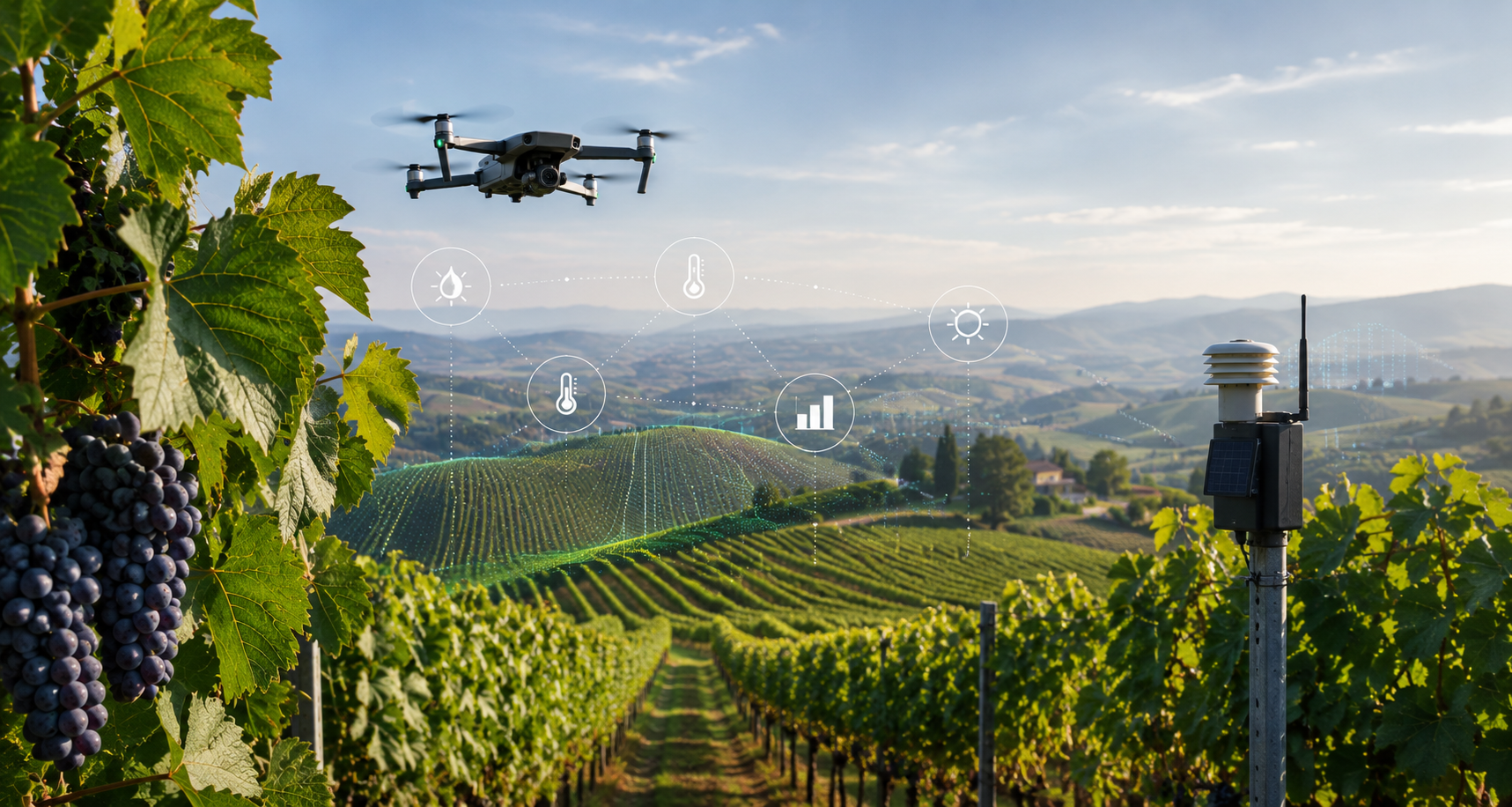
Viticulture is among the agricultural sectors most exposed to climate pressure. Growers now face higher temperatures, water stress and a shortage of skilled labour. In response, technologies such as remote sensing, drones and decision support systems have moved from research centres into daily vineyard practice, where they help improve grape quality and reduce environmental impact.
The Agri-Digital Growth course on Precision Viticulture makes such technologies accessible to SMEs, graduates and professionals across Central Europe. Produced by MATE, the Hungarian University of Agriculture and Life Sciences, the course is now available on ICARUS, the e-learning platform developed by project partner 28DGTL. It forms part of the five pilot courses that the partnership has designed to close the digital skills gap in the agri-food sector.
The course is organised into eight modules that follow the path from the vine itself to its digital management. It starts from the foundations of viticulture, the biology and morphology of the grapevine and the main vineyard practices, then introduces precision viticulture and its core applications, from irrigation and plant monitoring to nutrition and disease management. A final module gathers real case studies drawn from research and field projects. The eight modules are:
Introduction to Viticulture
Vineyard Practices
Introduction to Precision Viticulture
Irrigation Strategies
Plant Monitoring
Nutrition Management
Disease Management
Case Studies
Across the modules, learners work on concrete tools and methods: rootstock selection and canopy management, water stress assessment through pressure chamber and thermal camera, remote and proximal sensing, multispectral sensors, soil and leaf analysis, as well as decision support systems for irrigation and fungal disease prevention.
Like the other ADG pilot courses, Precision Viticulture follows a micro-credential structure of around 25 hours. Between eight and twelve hours go to video lessons prepared by the partners’ experts, around two hours to quizzes and the final test. The remaining time is left for individual study through a dedicated resources section. Learners who complete the full course and pass the final test receive a certificate of completion. Those who follow Precision Farming Basics and one specialised course of their choice obtain the Precision Farming Specialist certification. Learners who do not need a certificate can also select single modules according to their interests.
The course addresses junior profiles in traditional SMEs as well as PhD and master’s degree holders who want to align their competences to the requirements of modern viticulture. Access is open and free of charge.
The courses are available on the 28Digital platform: https://28digital.ea.education/adg/
They are also available on the Agri-Digital Growth website: https://www.agridigitalgrowth.eu/pilot-courses-and-how-to-apply/