
Pilot concept
Standard tram vehicles operating in daily passenger service were equipped with advanced sensors, communication modules, and edge computing units. These systems continuously collect data on:
- overhead contact line condition
- track and track bed infrastructure
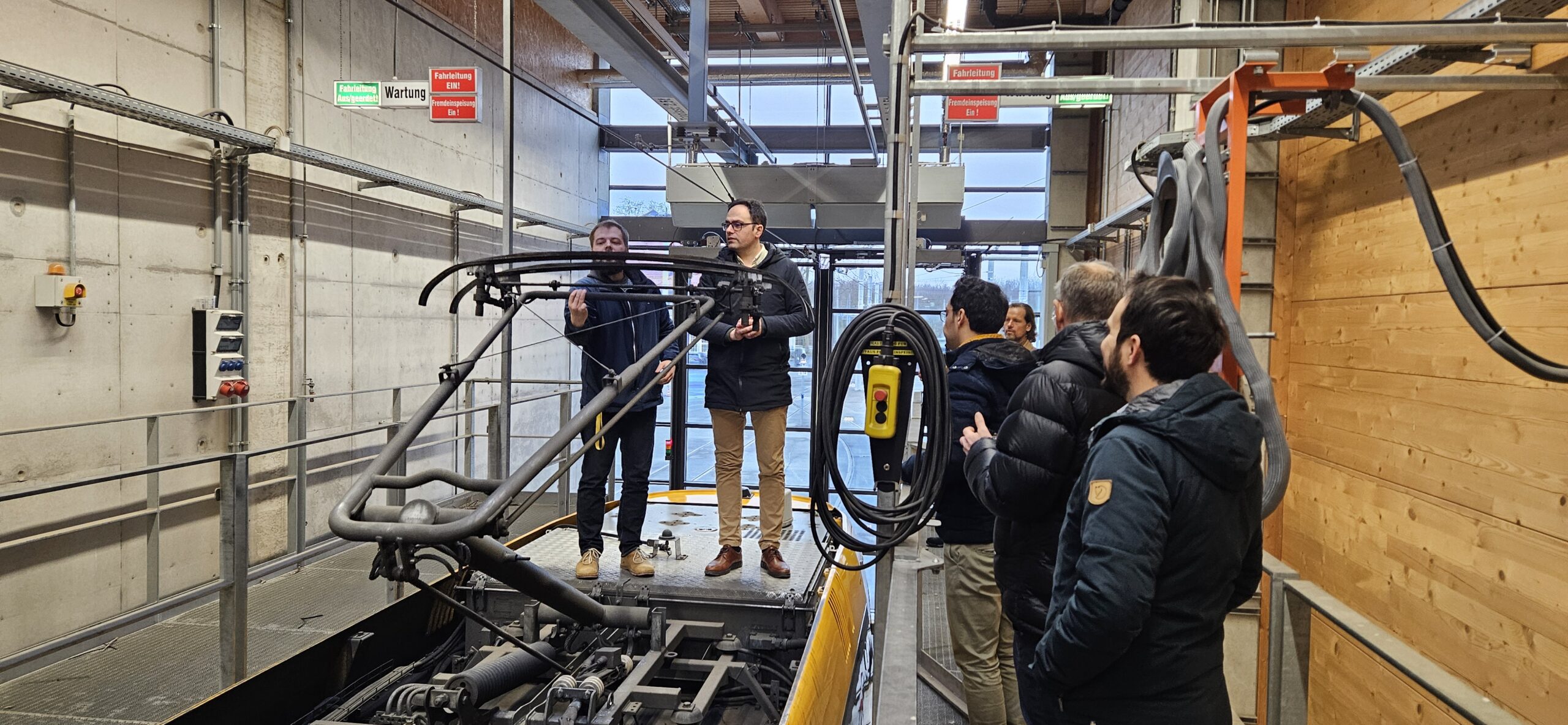
- pantograph–catenary interaction
- vehicle dynamics and operational parameters
The collected data is processed using advanced analytics and AI-based methods to detect early indicators of wear, faults, and infrastructure degradation. A key feature of the pilot is the combination of real-world monitoring data with simulation-based insights, allowing validation of observed system behaviour and supporting more accurate maintenance and planning decisions.
Implementation approach
The pilot was structured into three main phases:
Preparation phase
Definition of system requirements, sensor selection, vehicle integration planning, data architecture setup, and training of operational staff.
Implementation phase
Installation and activation of onboard monitoring systems, initiation of real-time data collection, sensor calibration, and development of data processing and analysis workflows. Continuous feedback loops were established between technical partners and LVB experts.
Evaluation phase
Assessment of system performance under real operating conditions, identification of infrastructure anomalies, validation of predictive maintenance capabilities, and refinement of analytical methods.
Roles of the partners
The Leipzig pilot was implemented through close cooperation between several specialised partners: LVB (Leipziger Verkehrsbetriebe GmbH) – system operator, providing operational environment and validation context KRUCH Railway Innovations GmbH & Co. KG – system architecture, sensor integration, data analytics, and project coordination Ci4Rail GmbH – provision of rail-certified onboard hardware for data acquisition and transmission CEMIT Group – development of track infrastructure monitoring and analysis tools PANTOhealth GmbH – development and application of monitoring and diagnostic methods for overhead contact line and pantograph interaction, including real-time signal analysis and defect detection During the initial operational phase, the system was supervised in real time by KRUCH together with its subcontractors, ensuring stable performance, data integrity, and proper system behaviour under live conditions.
Key results and outcomes
The Leipzig pilot has delivered several important results:
- early detection of infrastructure irregularities and vibration anomalies
- improved understanding of pantograph–overhead line interaction in daily operation
- more targeted and condition-based maintenance planning
- reduction of unplanned infrastructure-related disruptions
- validation of real-world data against simulation and analytical models
- initial insights into energy consumption monitoring and optimisation potential
The pilot also highlighted the importance of high-quality, reliable data streams, leading to further improvements in data integration approaches, including enhanced energy data collection strategies from onboard systems.
Impact and outlook
The results of the Leipzig pilot demonstrate the strong potential of combining predictive maintenance, real-time monitoring, and simulation-supported decision-making in urban rail systems. By shifting from reactive maintenance towards condition-based strategies, public transport operators can achieve:
- extended infrastructure lifetime
- reduced maintenance costs and material use
- improved operational reliability
- more efficient planning processes
- stronger sustainability performance
The approach developed in Leipzig is highly scalable and can be transferred to other lines, vehicles, and cities, contributing to the wider implementation of circular and data-driven public transport systems across Europe. A video summarizing the Leipzig pilot and its results is available here: https://youtu.be/TFXSpdlZ5C8