
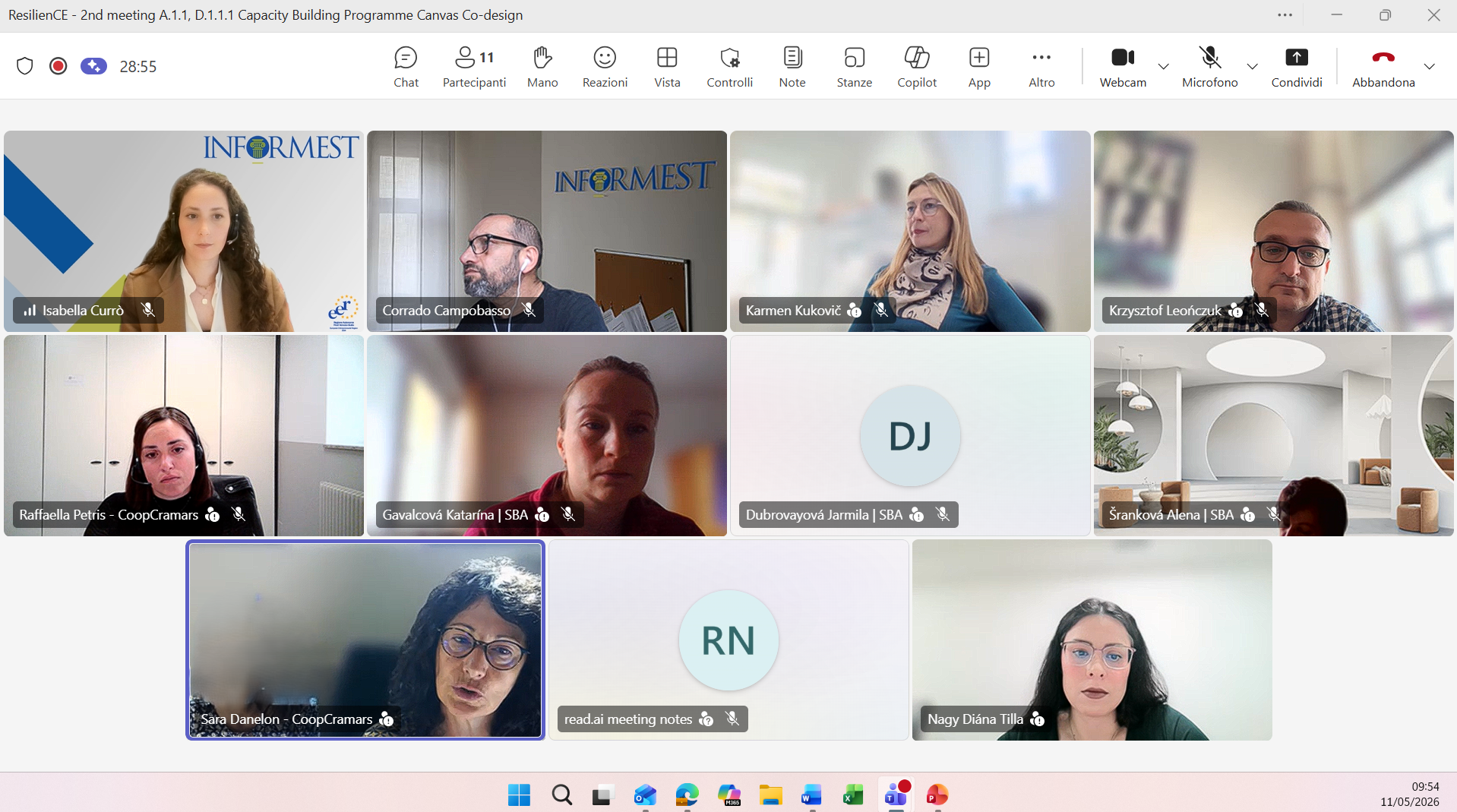
Partners of the ResilienCE project met on the 11th of May to further refine the structure and implementation of the Capacity Building Programme (CBP), a core project activity aimed at strengthening the resilience, sustainability and innovation capacity of social economy enterprises across the programme area.
A flexible and tailored Capacity Building approach
During the meeting, led by the LP Informest, supported by Cramars, the partnership reviewed the overall design, objectives, and modular structure of the Capacity Building Programme. The CBP is conceived as a flexible and tailored development pathway, capable of adapting to the different needs, maturity levels and sectors of participating social economy enterprises.
The programme combines horizontal modules, providing a common foundation (such as business models, governance, organisational development, financial sustainability and impact monitoring), with vertical modules, focusing on strategic themes including digital transition, green transition, integrated twin transition, inclusion and diversity. Modules can be combined and adapted based on the specific development stage of each enterprise.
Assessment and profiling of enterprises
A key element of the programme is the initial assessment and profiling process, based on a questionnaire. This tool allows partners and mentors to identify the business maturity level of each enterprise, with particular attention to digitalisation and sustainability dimensions. The results of the assessment guide the selection and activation of the most relevant modules and mentoring support.
Participation in the programme is reserved for social economy enterprises selected through a transnational call, with a target of 25 enterprises (five per country). Enterprises are selected on the basis of an innovative idea, which will be further developed and strengthened throughout the programme.
Differentiated support by maturity level
The partners discussed in detail how the Capacity Building Programme differentiates support across five maturity levels, ranging from early-stage stabilisation to advanced innovation and ecosystem leadership. Less mature enterprises will primarily benefit from horizontal modules, while more advanced organisations will access deeper, sector-specific and thematic vertical modules. Each level is associated with clearly defined expected outputs and operational tools.
Despite this differentiation, the programme maintains its cross-sectoral character, ensuring relevance for a wide range of activities, including social services, local production systems and sustainable tourism.
Conclusions and next steps
With the shared commitment of all partners, the ResilienCE project is moving towards the implementation phase of its Capacity Building Programme. The participatory refinement of tools, modules and mentoring approaches ensures both coherence at transnational level and flexibility at local level. The forthcoming activities will translate this joint work into concrete support for social economy enterprises, strengthening their capacity to face digital, green and societal challenges and contributing to more resilient communities across Central Europe.