
In April 2026, the ResilienCE project partnership further advanced its implementation by aligning on key activities and objectives aimed at strengthening social economy SMEs and enhancing the resilience and vitality of local communities, particularly in rural and peripheral areas.
A central focus of the recent thematic exchange was the Capacity Building Programme (Activity 1.1), designed as a core instrument to help social economy enterprises improve their organisational capacity, sustainability and innovation potential. The programme is structured around a flexible and modular approach, combining horizontal modules – addressing transversal business and management needs – and vertical modules dedicated to green and digital transition topics.
The programme is tailored to the maturity level and needs of each SME, ensuring relevance and feasibility for small organisations with limited internal resources. All participating enterprises will be required to articulate an innovative idea linked to the twin transition principles and to their local context, encouraging place-based solutions that respond to real community challenges and opportunities.
Strengthening Local Ecosystems Through Mentoring and Co-Design
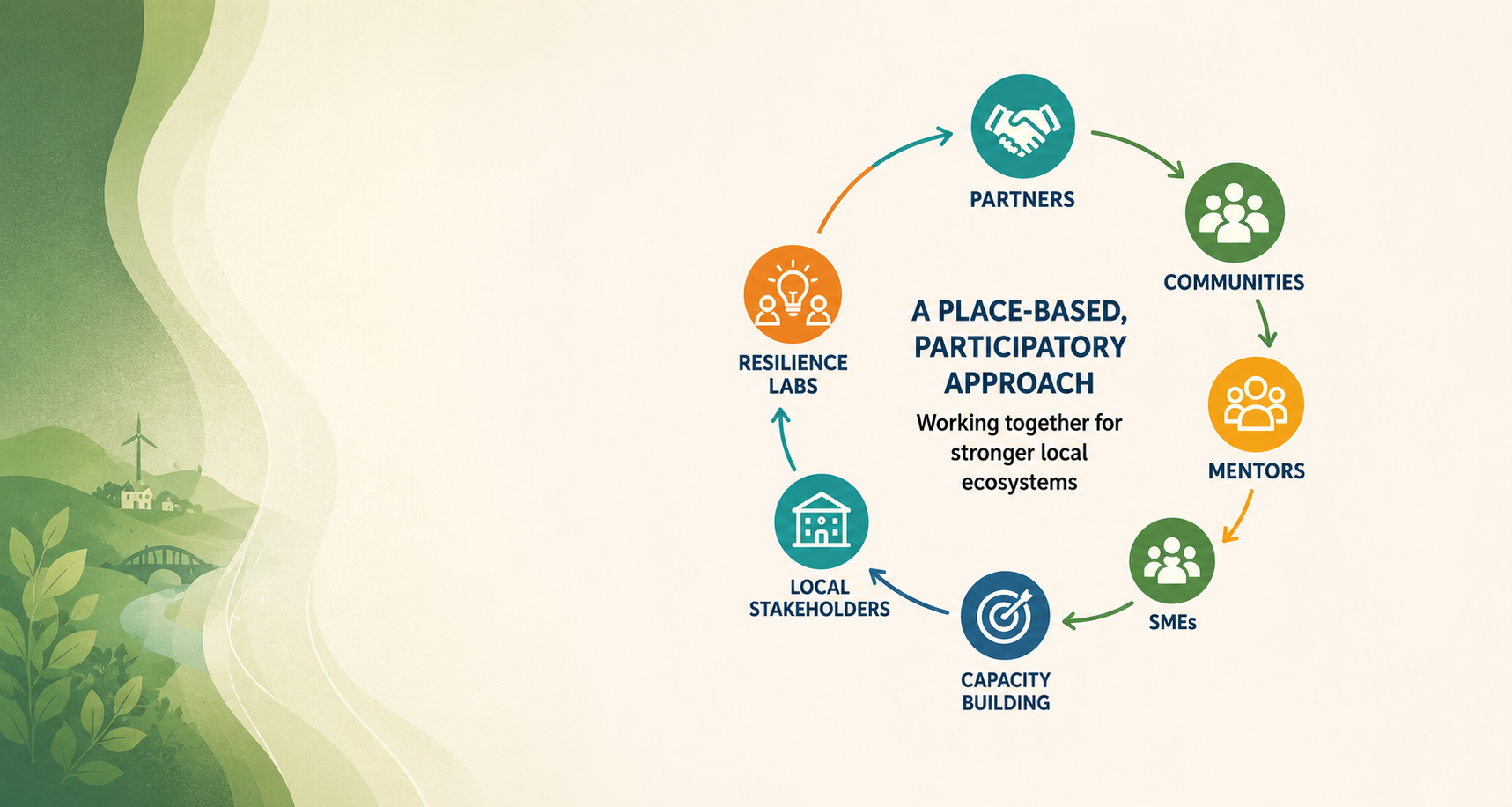
To ensure effective delivery on the ground, partners also refined the framework for Mentors Training (Activity 1.2). The training will align mentors across regions on project objectives, methodology and practical tools, creating a shared approach to supporting SMEs while allowing adaptation to local conditions. Peer learning, practical exercises and exchange among mentors will play a key role in strengthening this transnational support network.
In parallel, the Resilience Labs and Workshops (Activity 1.3) were further defined as spaces for cocreation and experimentation at local level. Through a series of workshops, covering sector mapping, needs assessment, case study analysis, business model co-design and skills gap identification, SMEs and local stakeholders will work together to strengthen local value chains, employment opportunities and community-based solutions.
From Capacity Building to Local Impact
Looking ahead, partners confirmed progress on the Transnational Call for Social Economy Enterprises (Activity 2.1), which will enable the selection of SMEs to participate in the capacity-building pathway. This will mark a transition from design to implementation, directly supporting enterprises that play a crucial role in local service provision, social inclusion and community cohesion.
The partnership also reaffirmed the importance of peer learning and exchange as a means to scale up successful approaches and inspire action across territories, with a dedicated exchange activity planned for high-performing SMEs in the next project phase.
Overall, the recent exchanges reinforced ResilienCE’s commitment to a place-based, participatory approach, supporting social economy SMEs not as isolated actors, but as key drivers of local resilience, inclusive growth and community development across Central Europe.