
In the Öresund region, the border is understood as one of the organising elements of everyday mobility, employment, education, economic relations and institutional cooperation. The opening of the Öresund Bridge played a decisive role in the development of the region; however, one of the most important lessons of the programme was that physical connectivity alone is not sufficient. Long-term political cooperation, trust, well-functioning information services, and the continuous management of legal and administrative obstacles are also needed.
The first day of the programme began at the Nordic House in Copenhagen, where Gyula Ocskay, Secretary General of CESCI, briefly presented the objectives of the BorderLabs CE project. This was followed by an overview of the institutional background of Nordic cooperation by Petar Cavala, expert of the Nordic Council of Ministers. His presentation highlighted that cooperation between the Nordic countries does not function as a supranational model, but rather as an intergovernmental system between sovereign states, based on consensus and strong institutional trust.
The central theme of the morning was freedom of movement and the management of border obstacles. Sandra Forsén and Vera Lindström, representatives of the Freedom of Movement Council, explained how they identify, analyse and prioritise the problems that make everyday life more difficult for people living, working, studying or commuting in another Nordic country. Obstacles related to taxation, social security, pensions, digital identification or population registration clearly show that continuous policy work is needed even in regions characterised by a high level of trust and integration.Participants of the study visit also gained insight into the operation of Info Norden and regional information services. Louise Fabricius Lindeen presented how these services help citizens and businesses navigate the practical questions of cross-border life, while also providing important signals to decision-makers based on recurring cases. One of the key lessons of the study visit was precisely that citizen enquiries are not merely individual cases, but can also serve as valuable sources for identifying systemic obstacles.
At the end of the morning programme, Linus Owman presented the Nordic approach to societal security, preparedness and resilience. His presentation pointed out that crisis situations, the protection of critical infrastructure, energy supply, digital security and the resilience of healthcare systems are all issues that do not stop at national borders. Cross-border cooperation is therefore becoming increasingly important from the perspective of preparedness and long-term societal resilience as well.
After the joint lunch, participants continued the programme at the Greater Copenhagen Secretariat, where Managing Director Jan Juul Christensen and Senior Adviser Eva Englund presented the work of the organisation. Greater Copenhagen brings together regional and local actors from Southern Sweden and Eastern Denmark, with the main objectives of promoting growth, labour market integration, infrastructure development and the green transition. The examples presented clearly illustrated that cross-border cooperation is often driven by very concrete economic asymmetries: while there is a significant labour shortage on the Danish side, unemployment is higher in certain areas of Southern Sweden.
In the afternoon programme, Magnus Schönning presented the Interreg Öresund-Kattegat-Skagerrak programme, followed by a presentation by Christian Hald Mortensen on the work of the STRING Megaregion, stretching from Oslo to Hamburg. The presentations highlighted that Interreg is not only a source of project funding, but can also function as a policy laboratory for cross-border cooperation. The example of STRING demonstrated that cross-border cooperation can also be interpreted on a larger scale, as a megaregional development corridor, where infrastructure, innovation, green industrial technologies and competitiveness become mutually reinforcing factors.
The second day began at the residence of the Swedish Ambassador in Copenhagen, where Hans Wallmark, Ambassador of Sweden to Denmark, welcomed the participants and presented the significance of Danish-Swedish cooperation from a diplomatic and intergovernmental perspective. The group then crossed the Öresund Bridge by train. The joint journey itself vividly illustrated how border crossing becomes part of everyday practice in the region, and how the bridge connects the labour markets, institutions and urban spaces of the two countries.
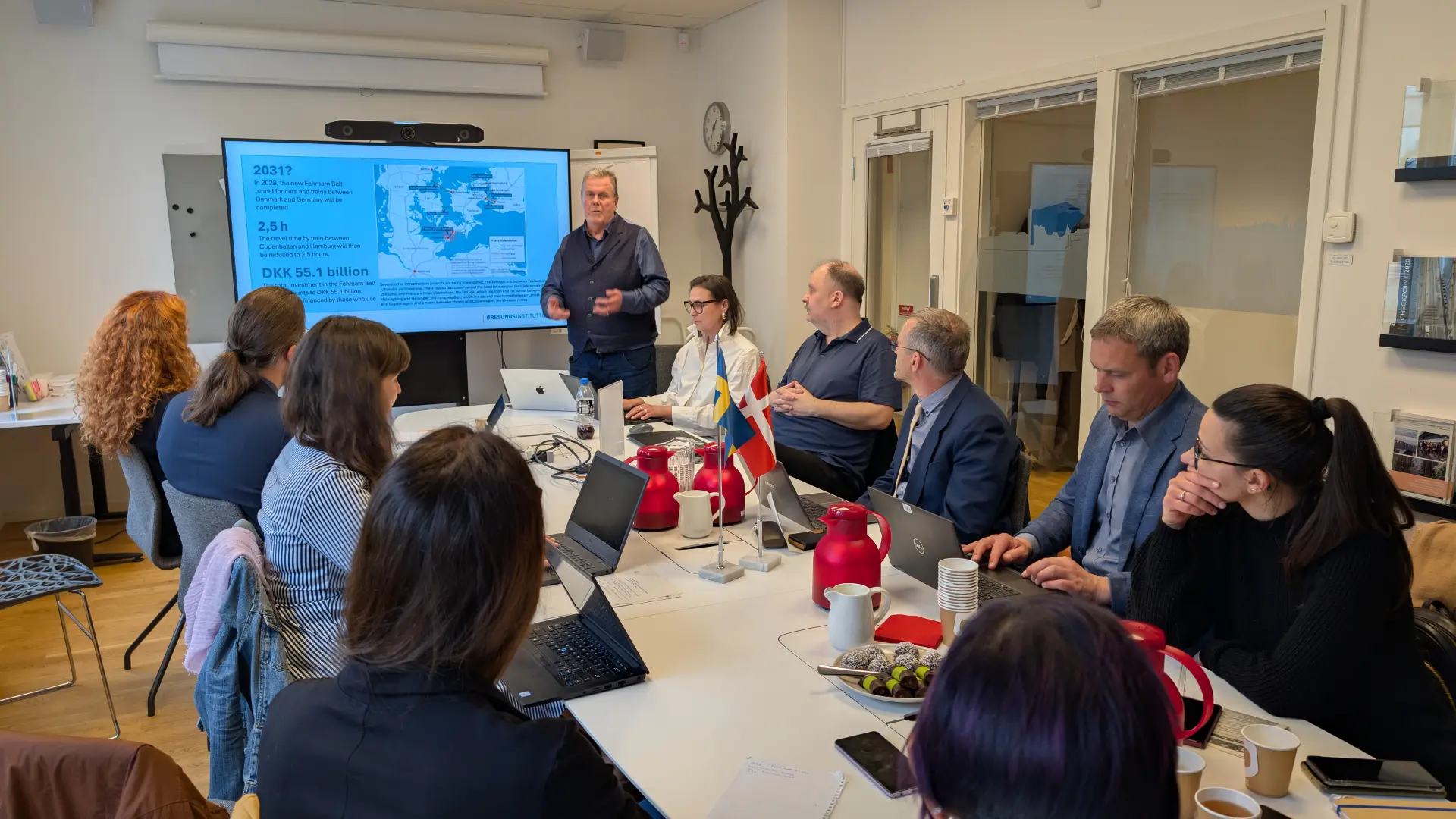
In Malmö, the programme continued at Øresunddirekt, where Johan Wessman, CEO of Øresundsinstituttet, presented the development of the Öresund region, the historical background of integration and its current challenges. His presentation pointed out that, following the opening of the bridge, commuting, residential mobility, business relations and research cooperation strengthened rapidly. At the same time, integration is not a linear process. The border closures during the COVID period, border controls, railway capacity constraints and difficulties related to digital administration all show that even the most successful border regions require continuous attention to the management of obstacles.
As the final professional stop of the study visit, Malin Dahl from Øresunddirekt Sweden presented the operation of the Danish-Swedish cross-border information service. For more than two decades, Øresunddirekt has been supporting citizens and businesses in practical matters related to employment, taxation, social security, digital identification and other cross-border issues. The service functions both as a citizen support point and as a sensor for systemic problems.
Overall, the study visit to Copenhagen and Malmö showed that the success of the Öresund region is not the result of a single investment or institution. The bridge, political cooperation platforms, information services, labour market initiatives, Interreg projects and megaregional strategies together form the ecosystem in which cross-border everyday life can become functional. For BorderLabs CE, all this provides important inspiration for the development of Central European border regions and for the more effective management of obstacles affecting everyday life.