

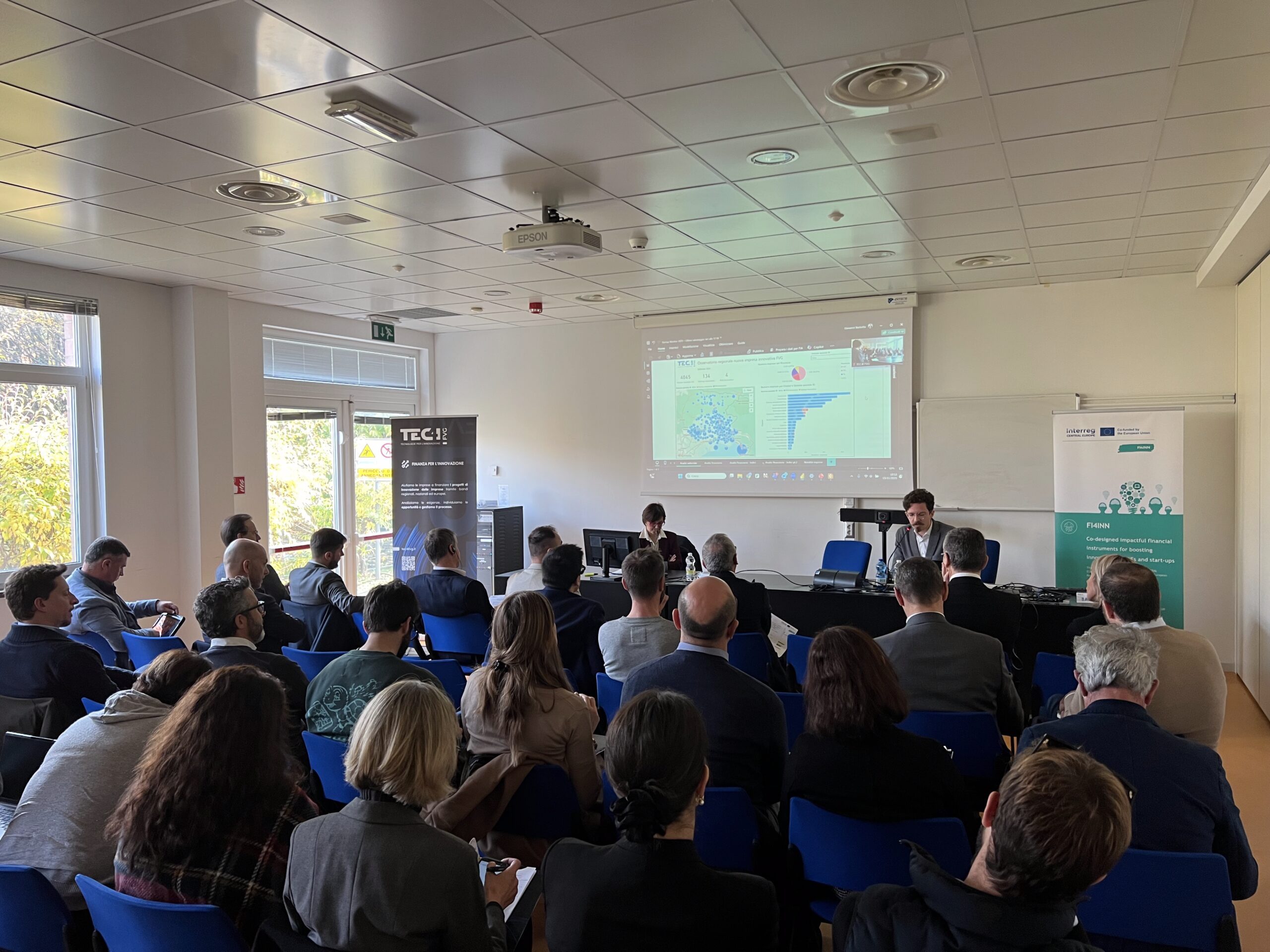
On 13 November 2025, FI4INN partners and regional stakeholders gathered in Udine (Italy) for the event “Financing Innovation: From Finance to Impact”, organised by TEC4I FVG. The event brought together public authorities, financial institutions, innovation actors, startups and SMEs to discuss how financial instruments can better support innovation and sustainable growth.
Strengthening access to finance through coordinated action
The event opened with institutional remarks highlighting the importance of aligning financial instruments with regional development strategies and improving access to finance for innovative businesses. The FI4INN project was presented as a key initiative supporting this transition, offering tools, methodologies and pilot actions to improve financial ecosystems across Central Europe.
A central theme throughout the discussions was the need to move from fragmented support schemes towards a more coordinated and strategic approach, where financial instruments are not only funding mechanisms but part of a broader system supporting company growth.
From data to policy: enabling evidence-based decisions
A key highlight of the event was the presentation of the Startup Monitor FVG, which demonstrated how data can support evidence-based policymaking. Participants discussed how better understanding startup dynamics—growth patterns, challenges, and financing needs—is essential for designing more effective financial instruments.
The discussion also emphasised the importance of monitoring and evaluation frameworks, aligning with FI4INN’s work on improving accountability and impact measurement in financial instruments.
Improving financial instruments for startups and SMEs
Several sessions focused on existing regional financial tools, including guarantees, incentives, and venture capital support schemes. While a variety of instruments are already available, participants highlighted recurring challenges:
- complexity and fragmentation of schemes
- limited accessibility for startups and SMEs
- need for clearer communication and guidance
In this context, instruments such as the Venture Capital Guarantee Fund were identified as particularly relevant for early-stage financing, with potential for further improvement through increased visibility and simplification.
Learning from transnational experiences
The event also featured contributions from FI4INN partners across Central Europe, showcasing different national approaches to innovation finance. Despite regional differences, a common direction emerged: the growing importance of blended finance models and flexible, modular instruments that can adapt to different stages of business development.
A case study on the LDV20 Funding Hub provided a practical perspective, highlighting the ongoing challenges faced by startups in areas such as financial planning, investment readiness, and market validation.
Integrating sustainability and impact into finance
Another key topic was the integration of ESG and impact criteria into financial instruments. Discussions confirmed a clear shift in expectations: sustainability is becoming a central element in accessing finance, with increasing emphasis on measurable environmental and social outcomes.
Regional initiatives promoting ESG awareness and competencies were presented as important steps towards aligning financial instruments with broader European sustainability objectives.
A platform for exchange and collaboration
With around 40 participants from across the regional and transnational innovation ecosystem, the event provided a valuable opportunity for dialogue, knowledge exchange, and networking. The diverse audience—including policymakers, financial actors, and entrepreneurs—ensured a comprehensive discussion covering both policy and market perspectives.
The event concluded with an open exchange among participants, reinforcing a shared vision: financial instruments must become more accessible, coordinated, and impact-oriented, supported by stronger data, clearer frameworks, and closer collaboration across stakeholders.