
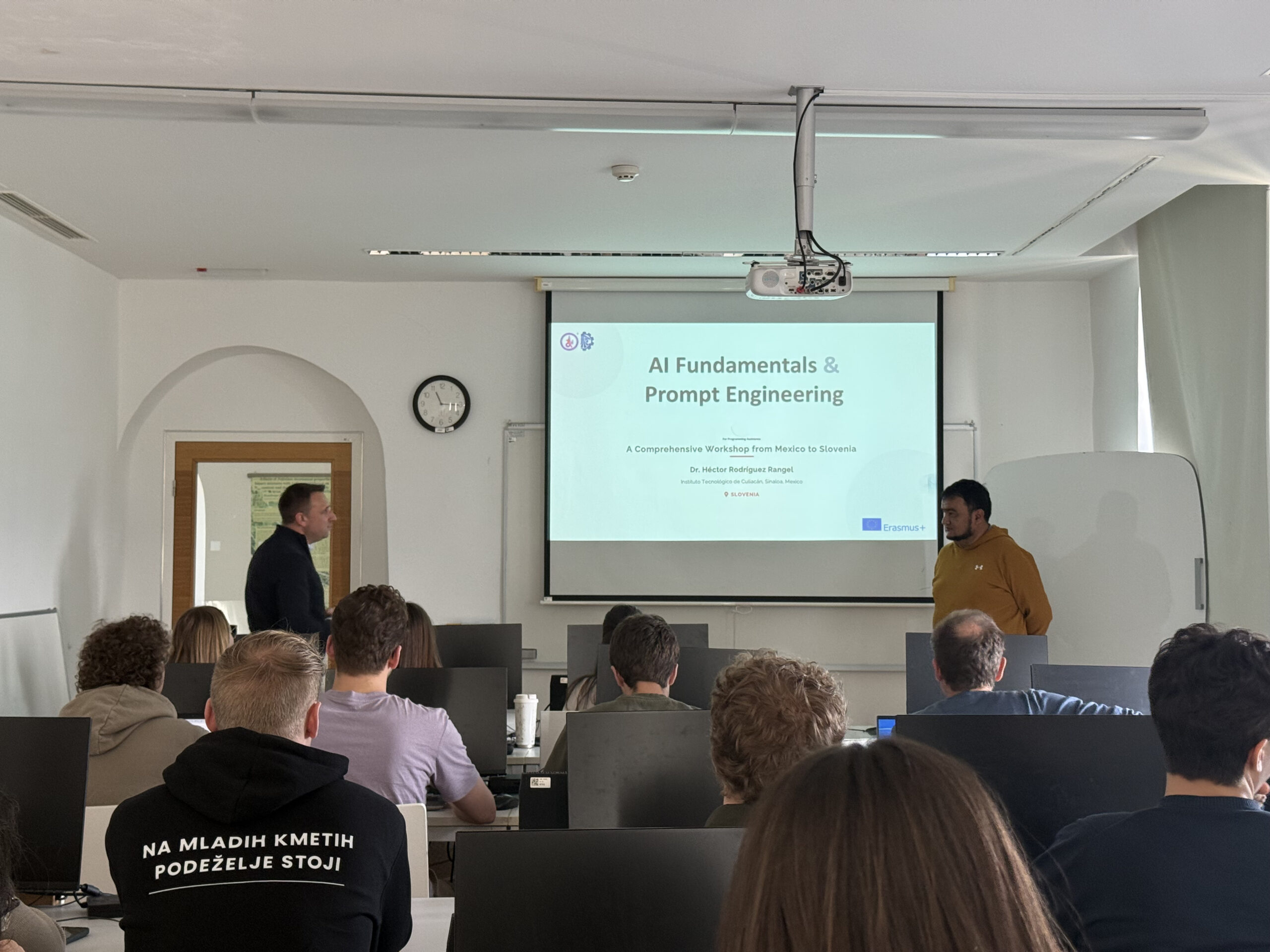
A two-week intensive course titled “AI and Machine Learning for Non-Computing Researchers” recently took place as part of the Erasmus+ KA171 mobility programme, run jointly with researchers from Culiacán, Mexico.
Artificial intelligence algorithms have become relevant across a vast range of scientific disciplines. Biologists, economists and social scientists increasingly rely on AI tools to analyse the data their research generates. Until recently, however, developing and applying these solutions demanded a level of computational expertise that most domain specialists do not hold. Recent advances in generative AI have significantly reduced that barrier: researchers can now use natural language to build, clean, train and validate sophisticated machine learning models, without programming knowledge.
The course guided participants through the full lifecycle of AI model development. The curriculum opened with prompt engineering and data preparation techniques, then moved to the training and comparison of classical machine learning models – linear regression, k-NN and random forest – evaluated through metrics including accuracy and the confusion matrix. The programme subsequently expanded into deep learning: participants worked with neural networks for tabular data classification, convolutional networks for image processing through transfer learning, and sequential models for time series forecasting.
The concluding phase integrated classical machine learning and generative AI to produce functional APIs and automated reporting tools. Each participant completed the programme with a fully operational AI system, covering dataset preparation, model evaluation and AI-generated documentation.
The initiative is part of Agri-Digital Growth’s commitment to building a Precision Farming Knowledge Transfer Ecosystem across Central Europe – equipping researchers, professionals and SMEs with the digital competences needed to drive the transition to data-driven agriculture.