
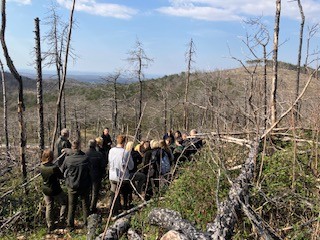
On Friday, 20 March 2026, a workshop on identifying close-to-nature solutions for forest restoration after natural disturbances was held in the area affected by the catastrophic 2022 wildfire on the Goriška Karst. The workshop was organized by the Interreg Central Europe RE-ENFORCE project, in cooperation with the Slovenian Forestry Institute (GIS), the Slovenia Forest Service (ZGS), and with contributions from the Horizon Europe OptFORESTS project. The workshop featured an in-depth discussion on various forest restoration approaches following large-scale disturbances, with particular emphasis on close-to-nature post-fire forest regeneration.
Although Slovenia is not directly included as a case study with a designated action plot within the RE-ENFORCE project framework, it faces comparable challenges related to large-scale forest fires and post-disturbance forest restoration observed across Central Europe. In this context, the workshop explicitly positioned Slovenian post-fire sites within a comparative framework, drawing parallels with RE-ENFORCE action plots in Italy and Poland. Particular attention was given to analysing fire-induced stand degradation, regeneration dynamics, and applied restoration measures across these sites.
The discussion addressed differences in national policy and governance frameworks influencing post-disturbance forest management, including planning procedures, funding mechanisms, and implementation capacities. In addition, participants critically examined key issues identified in the RE-ENFORCE policy briefs, including the availability and deployment of forest reproductive material, the role of close-to-nature silviculture, post-disturbance monitoring systems, and cross-sectoral coordination in restoration planning.
Participants were welcomed by Boštjan Košiček, Head of the Sežana Regional Unit of the Slovenia Forest Service, who outlined the key developments during and after the 2022 large-scale wildfire, including suppression activities, salvage operations, and the initial phases of post-fire restoration planning.
The programme continued with a field visit to a research plot near Kostanjevica na Krasu, where Boris Rantaša from the Slovenian Forestry Institute presented an experimental trial focused on improving planting success under drought-prone Karst conditions. The trial included the use of water-retaining soil amendments (hydrogels) to mitigate post-planting water stress and in situ mycorrhization to enhance root symbiosis and nutrient uptake. He also demonstrated a high-precision georeferencing protocol for individual seedlings using GNSS technology, enabling long-term monitoring of survival, growth, and treatment effects at the level of individual planting positions. The site additionally included a pilot direct seeding approach using seed balls distributed by unmanned aerial systems, representing an alternative to conventional planting in inaccessible or large burned areas.
This was followed by a visit to a fire-degraded stand left to natural regeneration. Participants evaluated early successional processes, including resprouting dynamics of native species and competitive interactions with invasive alien woody species. The site was presented by Matej Kravanja, who highlighted operational challenges in managing naturally regenerating areas, particularly the trade-offs between passive restoration and active intervention.
At the final field location, participants visited a recently planted restoration site established with public participation. A substantial proportion of planted seedlings exhibited severe damage, most plausibly attributable to rodent herbivory. This observation triggered discussion on the necessity of integrating effective protection measures—such as physical barriers, repellents, or population control—into regeneration planning, especially in post-disturbance environments where herbivore pressure can significantly compromise regeneration success.
The indoor (cabinet) session commenced after lunch. Andrej Breznikar presented key principles of close-to-nature silviculture in the context of increasing climatic variability, emphasising structural diversity, species-site matching, and adaptive management. Matej Kravanja provided a detailed operational overview of post-fire forest rehabilitation measures implemented on the Goriška Karst following the 2022 event, including site preparation, species selection, and tending regimes.
Boris Rantaša then contextualised current restoration efforts within the historical trajectory of afforestation and reforestation in the Karst region, where long-term human intervention has played a decisive role in shaping present-day forest structure and composition. He concluded with forward-looking perspectives on the development of restoration practices within the public forestry sector and the role of ongoing projects such as Interreg Central Europe RE-ENFORCE and Horizon Europe OptFORESTS in advancing knowledge transfer and innovation.
The final presentation was delivered by Marjana Westergren, who presented key findings on European systems for forest reproductive material (FRM), including constraints in seed supply, genetic considerations, and nursery production capacity under changing climatic conditions.
The key current challenges of forest restoration in the Karst, synthesised from both field observations and expert discussion, include ensuring sufficient availability and appropriate provenance selection of forest reproductive material across the entire production chain; establishing a robust, standardised monitoring system capable of supporting evidence-based decision-making; and implementing effective protection and tending measures to secure regeneration success and long-term stand development.
Looking ahead, these challenges are expected to intensify. Declining stand increment and the loss of highly productive stands are occurring in parallel with increasing demand for woody biomass and carbon sequestration. The spread of invasive alien tree and shrub species continues to alter successional trajectories and complicate management interventions. At the same time, societal expectations regarding forest ecosystem services are expanding, particularly from the domains of biodiversity conservation and cultural heritage. Operational constraints are further compounded by anticipated labour shortages and the growing need for mechanisation and automation in forest operations.
A key strategic priority identified during the discussion is the development of a reliable supply system for forest reproductive material encompassing a wide range of native, site-adapted species suited to Karst conditions. The establishment of a local forest nursery in the Karst region was highlighted as a potentially high-impact measure in this regard. In addition, participants proposed several innovative approaches to address current limitations, including improved coordination between research and practice, integration of new technologies, and adaptive policy frameworks. The workshop concluded with a shared position that continued expert exchange and cross-regional comparison—particularly within the RE-ENFORCE framework—remain essential for advancing effective forest restoration strategies.