
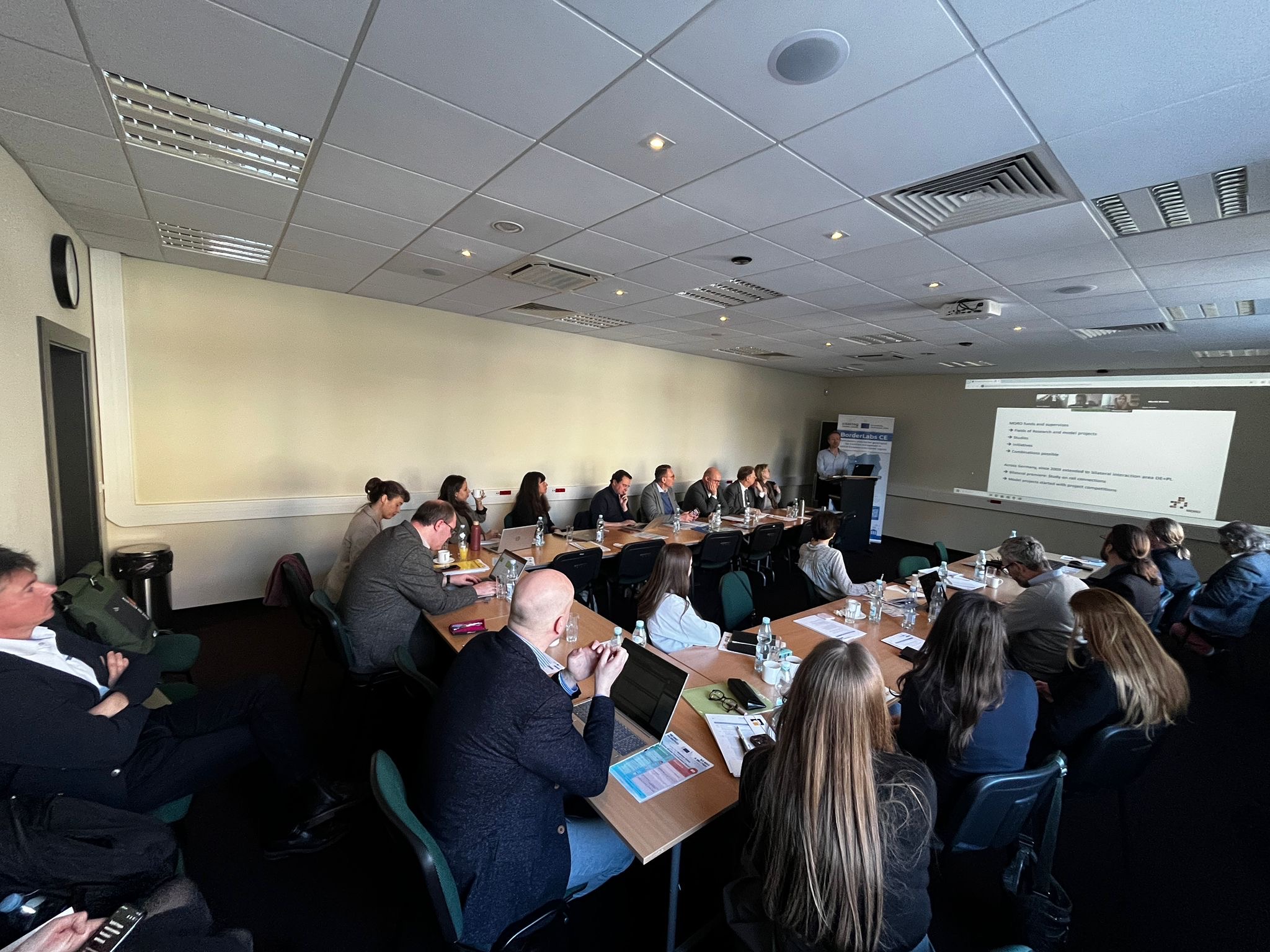
Partner meeting and thematic workshop of the BorderLabs CE project in Wrocław
On 2 and 3 March, the partners of the BorderLabs CE project met in Wrocław, Poland, to discuss the prospective final steps of the project and to exchange knowledge on the management of cross-border legal obstacles. The guests were hosted by the IRT, the Institute for Territorial Development. CESCI was represented by Gyula Ocskay, secretary general.
At the partner meeting, the participants representing the partner institutions discussed the PILOT-level tasks (compilation of the final reports, organisation of the final events, and administrative issues) and the project-level steps to be taken. In the latter, the organisational matters of the closing conference to be held on 10 June in Brussels to be organised under the umbrella of the European Cross-Border Platform, the charter for a more integrated Central Europe, and the multimedia learning platform to be developed were addressed.
The thematic workshop fitted into the series of events designed to analyse the three topics of the project, i.e. cross-border strategic planning, cross-border participatory governance and the management of cross-border obstacles. The event, moderated by Martin Reents on behalf of the lead Partner (the Government of Saxony), started with two comprehensive overviews. First, Dirk Peters, senior officer of the DG REGIO, an expert of the AEBR, presented the evolution of the EU toolkit supporting cross-border integration, from the financial incentives (Interreg), through the governance framework (the EGTC Regulation), to the obstacle management tool (the BRIDGEforEU Regulation). In the context of the last achievement, he highlighted that it is a voluntary tool; the Member States are not obliged to apply it, but there are strict deadlines set for the acts to be carried out by the authorities if a report on an obstacle is submitted. He also expanded on the procedures set by the Regulation. Martin Unfried (ITEM, University of Maastricht) used the Schakelpunt project and the territorial impact assessment studies of the ITEM Institute to illustrate the complexity and the potential ways of solving cross-border legal obstacles. The management of cross-border obstacles facilitates the development of public services with a 360-degree perspective, as he put it.
In the second panel, experts from relevant projects shared their experience with the audience. Dirk Gebhardt (BBSR, Germany) spoke about the German-Polish small projects co-financed under the MORO initiative, which targeted stronger cross-border integration. Carsten Jacob and Joanna Czasnojć (Euroregion Spree-Neiße-Bober) presented an Interreg project within the framework of which two Border Information Points have been opened to provide consultation for border citizens and assist them in managing their everyday cross-border problems. Since June 2025, when the service was launched, more than 750 people have been consulted and oriented towards the relevant authorities contracted by the project partner. Martin Hanf (Pomerania Euroregion) introduced a similar initiative dating back to 2009. Since then, the Euroregion has been operating a network of information offices in the German-Polish border area around Szczecin, with a strong focus on business cooperation.
The last panel included testimonies delivered by the project partners. The PILOT of Upper Austria directly targets several cross-border obstacles. Katja Rosner, the manager of the project, explained how their obstacle management activities had been evolving, covering the Bavarian and Bohemian border regions, where they had managed to identify 20 particular obstacles. The pilot was very successful in the subject of cross-border labour mobility. She also mentioned that the government of Upper Austria applied for the Commission’s call to set up a cross-border coordination point (CBCP) according to the BRIDGEforEU Regulation. Ondřej Havlíček (Association of Czech Euroregions) introduced the obstacle management system developed by the association before the inauguration of the EU Regulation mentioned above. The national contact point established by the association receives obstacle reports, and the association publishes calls for unfolding obstacles to be resolved. Due to the domestic legislation, the association could not become a CBCP.
Marcin Krzymusky, legal expert of the Frankfurt–Słubice Cooperation Centre, did not detail particular obstacles they have been facing since they launched the integration process of the two neighbouring towns, including several formats of participatory governance. On the contrary, Micaela Passon gave a comprehensive overview of the legal obstacles the EGTC GO has been witnessing during the implementation of their projects. These difficulties include public procurement, the reimbursement of the treatments related to cross-border health services, the different VAT rules in Italy and Slovenia applied for construction works (in the case of a cross-border cycle path), and even the rules to be adapted for cultural events at the cross-border square, which was the heart of the European Capital of Culture programs. Finally, Péter Nagy (Ister-Granum EGTC) presented illustrative examples on the failure of the Single Market, based on their experience with the cross-border retail of local products. Due to the fact that the production and trade rules of local products are defined at the national level, the certificates, VAT, invoicing, food hygiene rules, etc., are different, and the cross-border retail is very complicated. Within the framework of the BorderLabs CE project, the Ister-Granum EGTC will publish an online guide facilitating cross-border movement of producers and goods, including all relevant difficulties.
The final words were given by Gyula Ocskay, who summarised the lessons learnt from the workshop, focusing on the classification, the impacts and the potential solutions of cross-border legal obstacles, and their role in terms of cross-border integration.