
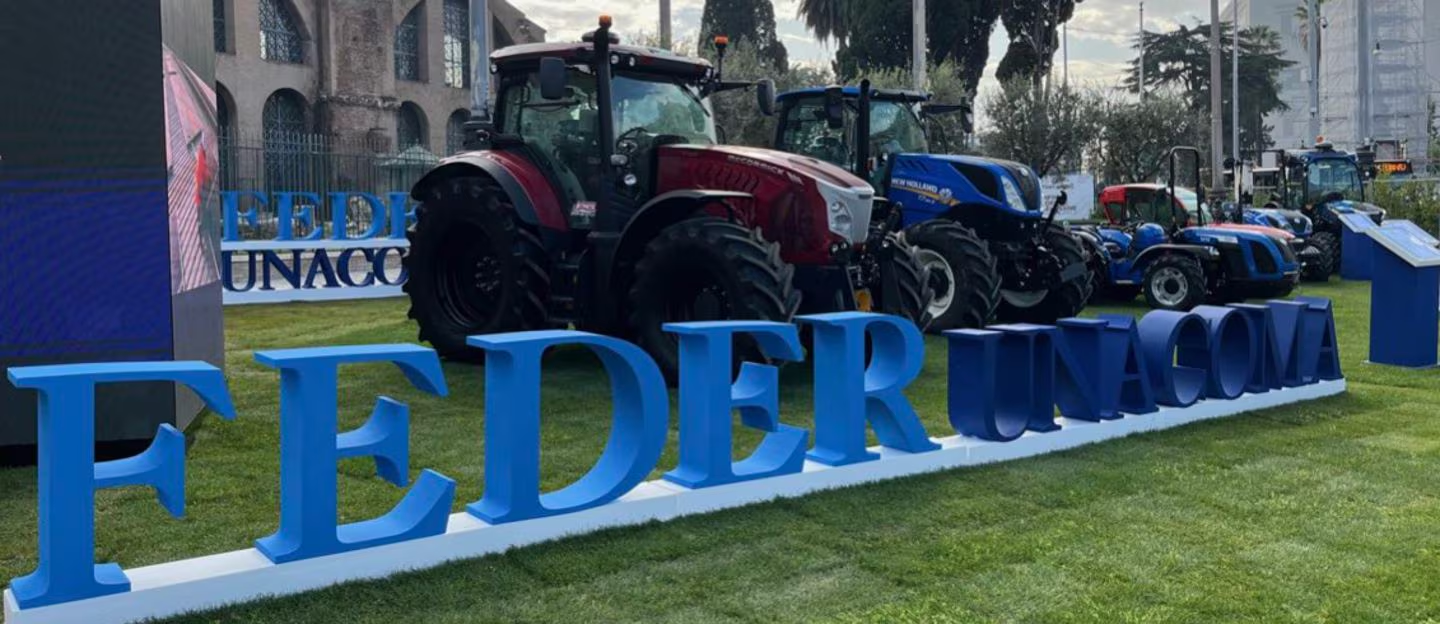
Around 650 students from agricultural technical and vocational schools took part in the School Days organised at Fieragricola, engaging in discussions on innovation, professional pathways and the future of the sector. During the initiative, FederUnacoma – partner of the Agri-Digital Growth project – met the students over several days of exchange. Lorenzo Iuliano, as Head of Education and Training for FederUnacoma, interacted directly with them throughout the programme.
Many of these students come from territories with a deep agricultural vocation; for some, farming is already part of their family background. The conversations revealed a sector in transition, interpreted through the eyes of a generation that does not approach agriculture as inheritance alone but as a field open to transformation.
“What struck me most was their curiosity,” Iuliano explains. Students were eager to understand how to continue their education and define their professional trajectory in a sector undergoing rapid transformation. As he observes, there is “a strong desire to change the paradigm, to break existing schemes.” The significant presence of young women also signalled that agriculture is expanding its professional landscape and diversifying its identity.
Questions about employment quickly moved to the centre of the exchange. Entry into the labour market became a recurring theme, as students sought clearer pathways linking education to real professional opportunities.
Discussions on innovation turned to concrete technologies. Drones attracted particular interest, followed by robotics and artificial intelligence. Students demonstrated a clear awareness of the role digital tools can play within professional practice. “The goal of AI is informed decision-making,” Iuliano notes, underlining that these systems enhance analytical capacity within complex operational environments and serve to support human expertise.
“They are extremely imaginative,” he adds. Their ideas are often unexpected, sometimes playful, yet insightful. What stands out is a genuine desire to contribute meaningfully to the future of the sector. In agriculture, this sense of vocation is particularly marked; it calls for structured preparation capable of translating enthusiasm into professional competence.
This is where Agri-Digital Growth intervenes.
As Iuliano explains, digitalisation needs to respond to real field conditions. “Digital innovation only works when it integrates effectively into operational routines,” he notes.
Agri-Digital Growth builds precisely on this premise. The project starts from existing operational realities and aligns technological innovation with the concrete needs of the sector. It is for this reason that, from late spring onwards, a series of free applied modules will address precision farming fundamentals, robotics, data processing, artificial intelligence and precision viticulture.
The impact concerns the way daily work is interpreted and evaluated. Access to structured data, clearer field diagnostics and measurable performance indicators enables operators to analyse variability with greater precision, monitor decisions over time and base improvements on evidence that can be verified and quantified.
Applied training occupies a central role in this process. It expands analytical capacity and consolidates professional autonomy. As Iuliano concludes, “It means having the tools to evaluate options independently, to gain a clearer and more systematic understanding of operational conditions.”