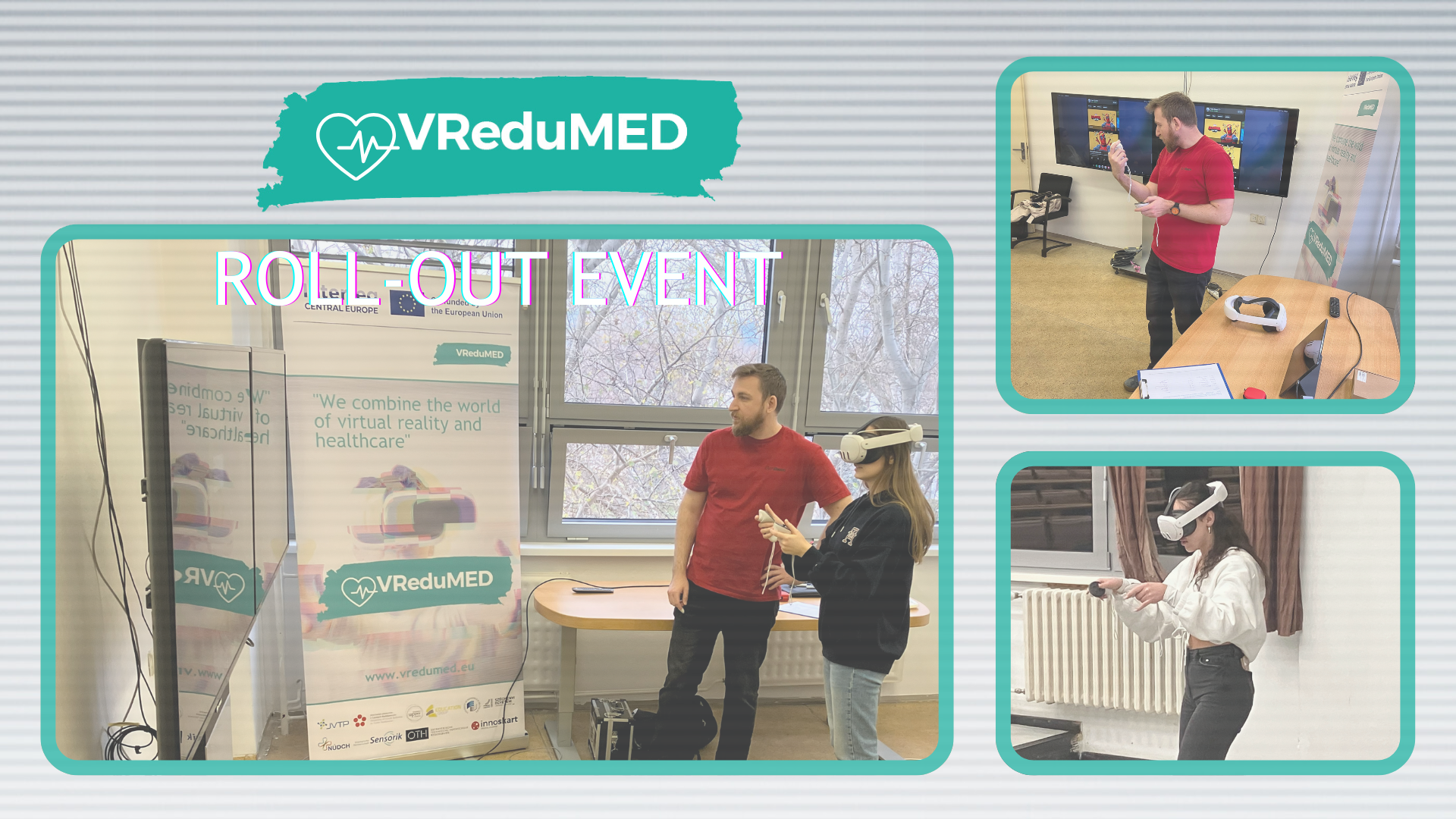
The Slovak partners of the VReduMED project — the Bratislava University of Economics and Business (EUBA) and the National Institute of Children’s Diseases (NUDCH) — successfully hosted a pilot testing roll-out event on 20th November, 2025, that introduced students from two academic fields to innovative VR applications developed within the project. Held on the premises of EUBA, the event brought together business students from EUBA and medical students from the Faculty of Medicine at Comenius University Bratislava for a hands-on exploration of immersive learning technologies. The event was organised in two consecutive sessions on the same day. In the morning, twenty-five students of economics and business experienced a workshop focusing primarily on CPR and work safety, complemented by additional VR tools that demonstrated broader possibilities for virtual reality in managerial training, workplace readiness, and organisational development. While some participants opted for guided demonstrations, many engaged directly with the technologies, testing their usability and offering valuable first impressions. In the afternoon, six medical students joined the second session, where all tested the VR applications hands-on. For this group, every tool used during the event — including clinical simulations and safety-oriented environments — was immediately relevant to their future professional practice. Their feedback enriched the testing with perspectives grounded in real clinical and educational needs. The pilot featured a selection of project-developed applications, such as VR CPR and Room of Horror, alongside best-practice tools mapped within the consortium, including Feartherapy, Human Anatomy VR, and Oxford Medical Simulation. Together, these applications provided a diverse overview of how virtual reality can enhance learning in healthcare, behavioural sciences, and professional training. Access to VR technology was designed to be beginner-friendly. Since many attendees had never worn a VR headset before, the sessions began with introductory briefings on VR navigation and device handling. Each application was introduced separately, clarifying controls, movement, and menu navigation. The testing used standalone VR headsets with real-time projection on a screen, enabling participants to follow each other’s progress. Throughout both sessions, representatives from EUBA and NUDCH provided support while encouraging participants to explore independently, thus generating authentic UI/UX feedback for the project’s further development. Reflecting on the event, Martin Novysedlák, EUBA, noted: “For many students, this was their first encounter with virtual reality. Watching them move from initial hesitation to confident exploration was a reminder of how transformative immersive learning can be when introduced in an accessible and supportive environment.” The Slovak roll-out event demonstrated the strong potential of VR-based educational tools within both business and medical training pathways. The insights gathered will contribute to the ongoing refinement of the VReduMED applications as the project progresses toward wider implementation across Central Europe.