
Increasing the use of secondary raw materials reduces dependence on primary resource extraction, lowers environmental impacts, and strengthens long-term resilience and sustainability across industrial sectors.
According to the European Environment Agency, recycled materials accounted for 11.5% of total material use in the EU in 2022, compared to 10.7% in 2010. Although this reflects gradual progress, current trends indicate that the EU is not yet on track to achieve its ambition of significantly increasing circular material use by 2030.
Circular economy strategies can support this transition by reducing material consumption, extending product life cycles, and improving reuse and recycling across value chains. In sectors such as construction, this is particularly important due to high resource demand and significant waste generation.
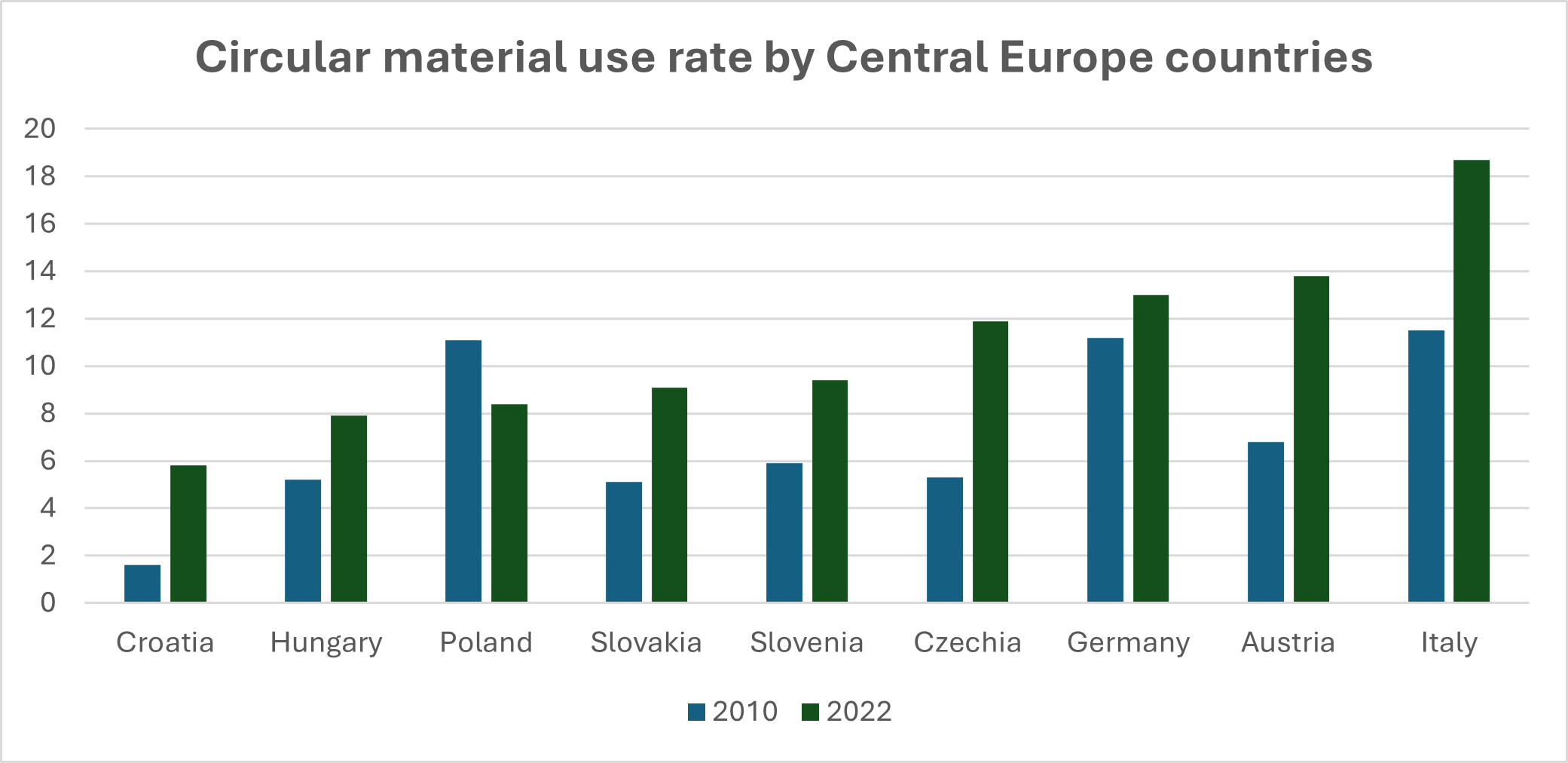
Across Central Europe, circular material use rates vary significantly, reflecting differences in recycling capacity, material flows, and national circular economy practices.
Examples of CMUR progress between 2010 and 2022 include:
| Country | 2010 | 2022 |
|---|---|---|
| Croatia | 1.6% | 5.8% |
| Hungary | 5.2% | 7.9% |
| Poland | 11.1% | 8.4% |
| Slovakia | 5.1% | 9.1% |
| Slovenia | 5.9% | 9.4% |
| Czechia | 5.3% | 11.9% |
| Germany | 11.2% | 13.0% |
| Austria | 6.8% | 13.8% |
| Italy | 11.5% | 18.7% |
These differences highlight both progress and continuing challenges in strengthening circular value chains across Europe.
Within the ReBuilt project, improving circularity in the construction sector was recognised as a key priority. By promoting reuse of secondary raw materials, stronger material traceability, digital solutions, and circular construction practices, ReBuilt contributed to broader efforts supporting resource efficiency and sustainable transformation in Central Europe.
Source: European Environment Agency, Circular Material Use Rate in Europe (2024)